The Flamingo satellites – owned and operated by Vyoma – are the backbone of the Vyoma Space Safety and Space Intelligence services . They enable Vyoma to generate Space Surveillance & Tracking data: surveillance enables cataloguing of space objects and event detection; whereas tracking allows the rapid follow-up on objects of interest.
Already with the first satellite, Flamingo-1, critical follow-up capabilities and observations of otherwise impossible-to-attain orbital regions are provided. With the full constellation of 12 satellites online, the revisit time for observations reduces to below 1 hour for all LEO targets. As a consequence, the Flamingo constellation is well-positioned to keep custody of prime targets in LEO.
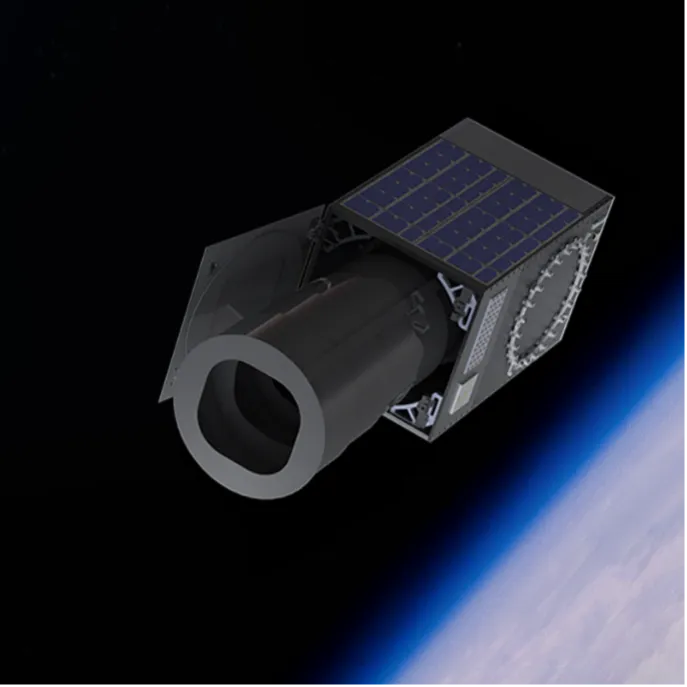
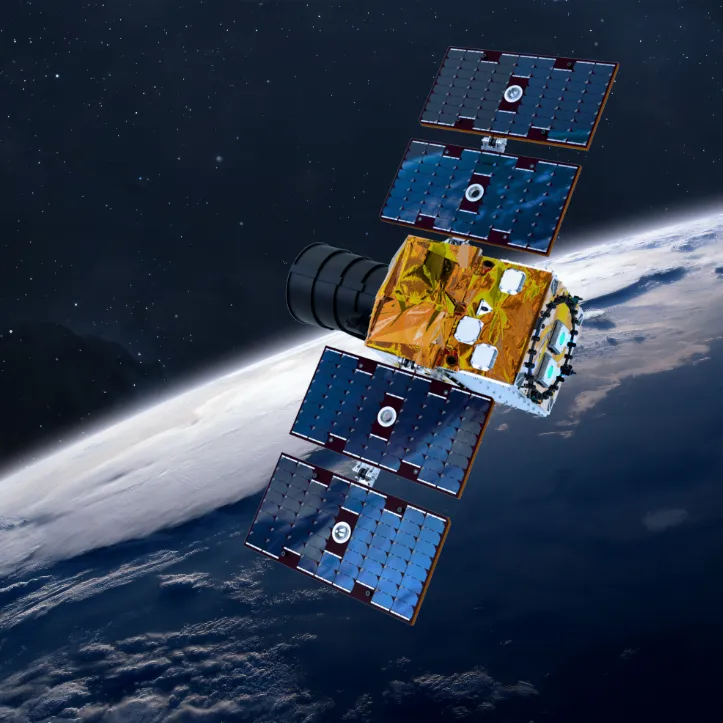

The Flamingo satellites produce images of the star background and space objects of interest, both recorded as streaks in each frame. The Vyoma Data Processing recognizes both, associates targets across images, performs astrometric reduction, and procedures unassociated Tracking Data Messages (TDMs).
The time-series approach enables Vyoma to produce data points with subpixel accuracy. Parallel implementations of classical and machine-learning based methods further increase the sensitivity and enable processing of images on-the-edge, that is on the satellite.
The ambition of Vyoma is to build-up and maintain a fully independent catalogue of space objects.
The Vyoma Catalogue is based on a multitude of services – time-bias estimation, (initial) orbit determination, track-to-track, track-to-orbit, and orbit-to-orbit association, and many more – with the aim to provide the most accurate orbital information on catalogued and currently uncatalogued objects.
A picture is worth a thousand words. Hence, we invite you to visualise your own constellation.
+49 (0) 89 21525339
contact@vyoma.space

